Why coatings fail near the coast
We repair a lot of floors in San Clemente, and the causes are usually the same:
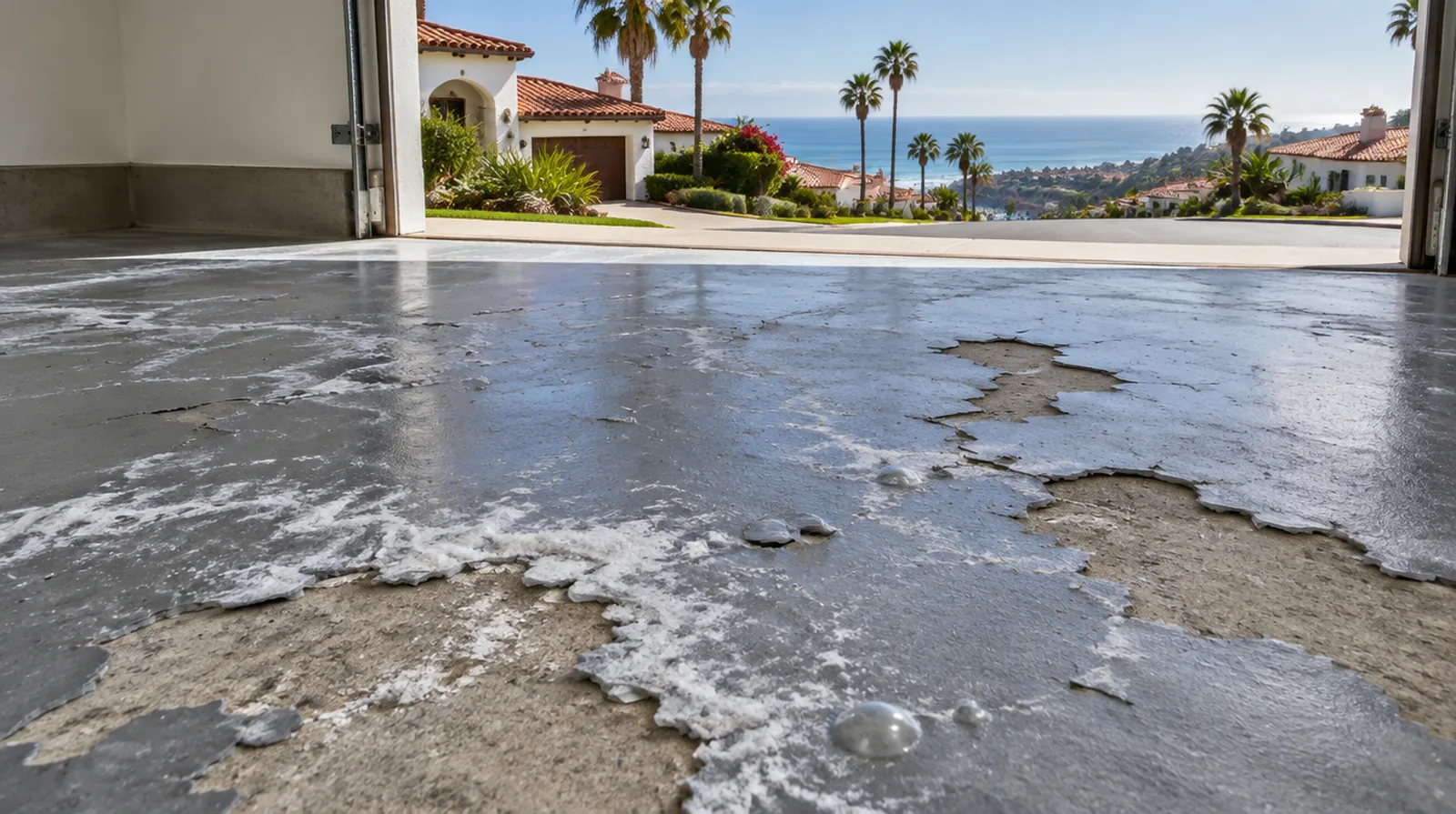
- Moisture vapor. Water rising through the slab pushes the coating up, creating bubbles and blisters.
- Salt. Salt carried by moisture builds up under the coating and breaks the bond, often showing as white powder at the edges.
- Poor prep. Coatings rolled onto unground or acid-etched concrete do not have enough grip.
- Thin kits. Store-bought products are too thin for daily car traffic.
- Hot tires. Soft coatings can stick to warm tires and pull off.
Repair or replace?
We start with an inspection. If the failure is limited to a few spots and the rest of the coating is well bonded, a repair makes sense. We cut out the bad area, grind the edges, fix the slab and blend in new material. If peeling or bubbling is spread across the floor, patching just moves the problem around. In that case, we recommend stripping the floor and starting over with proper prep and a moisture-rated primer.
Our repair process
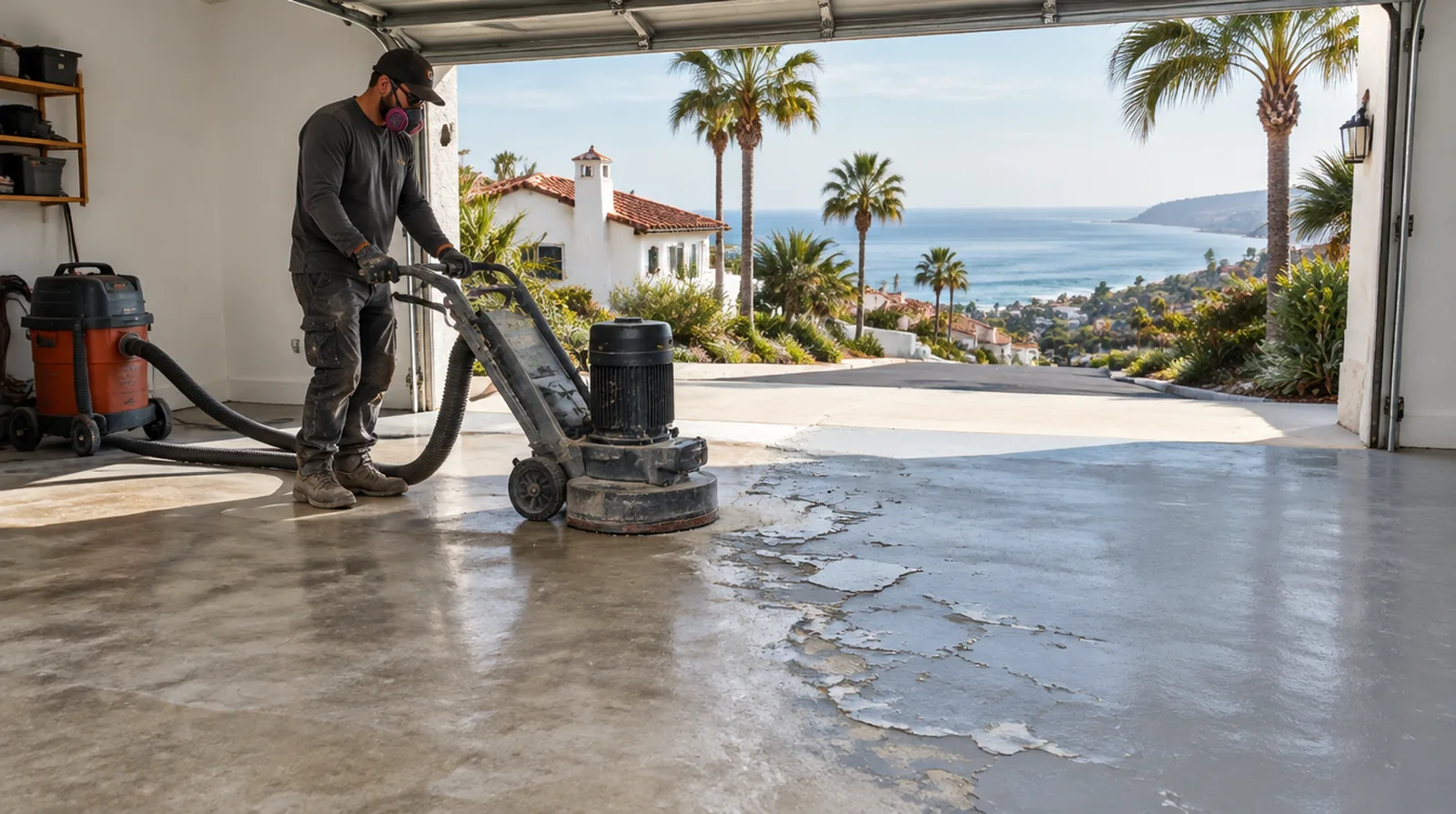
- Find the cause: moisture testing, bond checks and a look at the original prep.
- Remove loose and failed coating.
- Grind and clean the exposed concrete.
- Treat moisture and salt issues.
- Repair cracks and damaged concrete.
- Apply new coating layers to match or upgrade the floor.
Matching an existing floor
Exact matches are hard, especially with flake floors that have faded or worn over time. We do our best to blend, and in many cases we recommend a new clear topcoat over the entire floor so repaired and original areas look more uniform.
Full strip and recoat
When the floor needs to come off, we grind it down to clean concrete, test moisture, fix the slab and install a new system built for the conditions. Many customers use the opportunity to upgrade, moving from a basic kit to a flake floor or a fast polyaspartic coating.
Other fixes
- Repairing chips and gouges from dropped tools
- Fixing worn traffic paths
- Recoating dull or scratched floors
- Removing stains from older floors
- Repairing cracked or settled slabs before recoating
Warning signs
Watch for white powder at edges, bubbles that crunch underfoot, peeling near the garage door and cloudy patches. Catching problems early usually means a smaller repair.
Questions
Can you fix a floor another company installed?
Yes. We repair floors no matter who put them in.
Will the problem come back?
If we fix the cause, like moisture, the new floor should last. We explain the risk on every job.
How long does a repair take?
Small repairs often take a day. Full strip-and-recoat jobs take two to three days.
Send photos or book a free inspection. If the floor only needs a sealer after stripping, we will tell you.
Why the cause matters more than the patch
It is tempting to patch a peeling spot and move on, but on coastal slabs that rarely solves the problem. If moisture and salt pushed the old coating off, they will push the patch off too. That is why every repair starts with testing. We check moisture levels across the floor, look at how well the remaining coating is bonded and examine the back of the peeled pieces. Smooth, shiny undersides usually mean poor prep. White powder means salt and moisture. Once we know the cause, we can recommend a repair that lasts.
Sometimes the answer is a smaller repair plus a moisture barrier in the affected area. Sometimes the entire floor needs to come off. Either way, you get a clear explanation and a written estimate before any work starts.
We also look at the slab itself. Cracks that have shifted, settled sections near the garage door and spalled edges all need attention before any new coating goes down. Fixing the concrete first means the repaired floor sits on a solid base, and you are not paying to coat over a problem that will show through again in a year or two.
Schedule a floor inspection
Call (949) 429-4155 for a free estimate.